An 82-year-old patient planned for routine hip replacement developed rapid femoral head collapse and acetabular bone loss, requiring complex acetabular reconstruction. A real-world hip surgery case discussion.
In orthopaedic practice, not every “routine” case remains routine till the day of surgery. Hip arthritis, especially in elderly patients, can sometimes deteriorate rapidly—changing the entire surgical plan and demanding a far more nuanced approach.
This case is a reminder of why timely imaging, surgical flexibility, and experience in complex reconstruction are crucial in hip surgery.
When a Routine Hip Replacement Becomes a Complex Reconstruction
The Case at a Glance
An 82-year-old patient was listed under my colleague for what was expected to be a straightforward primary total hip replacement. Clinically, there were no dramatic red flags, and the plan was for a routine procedure.
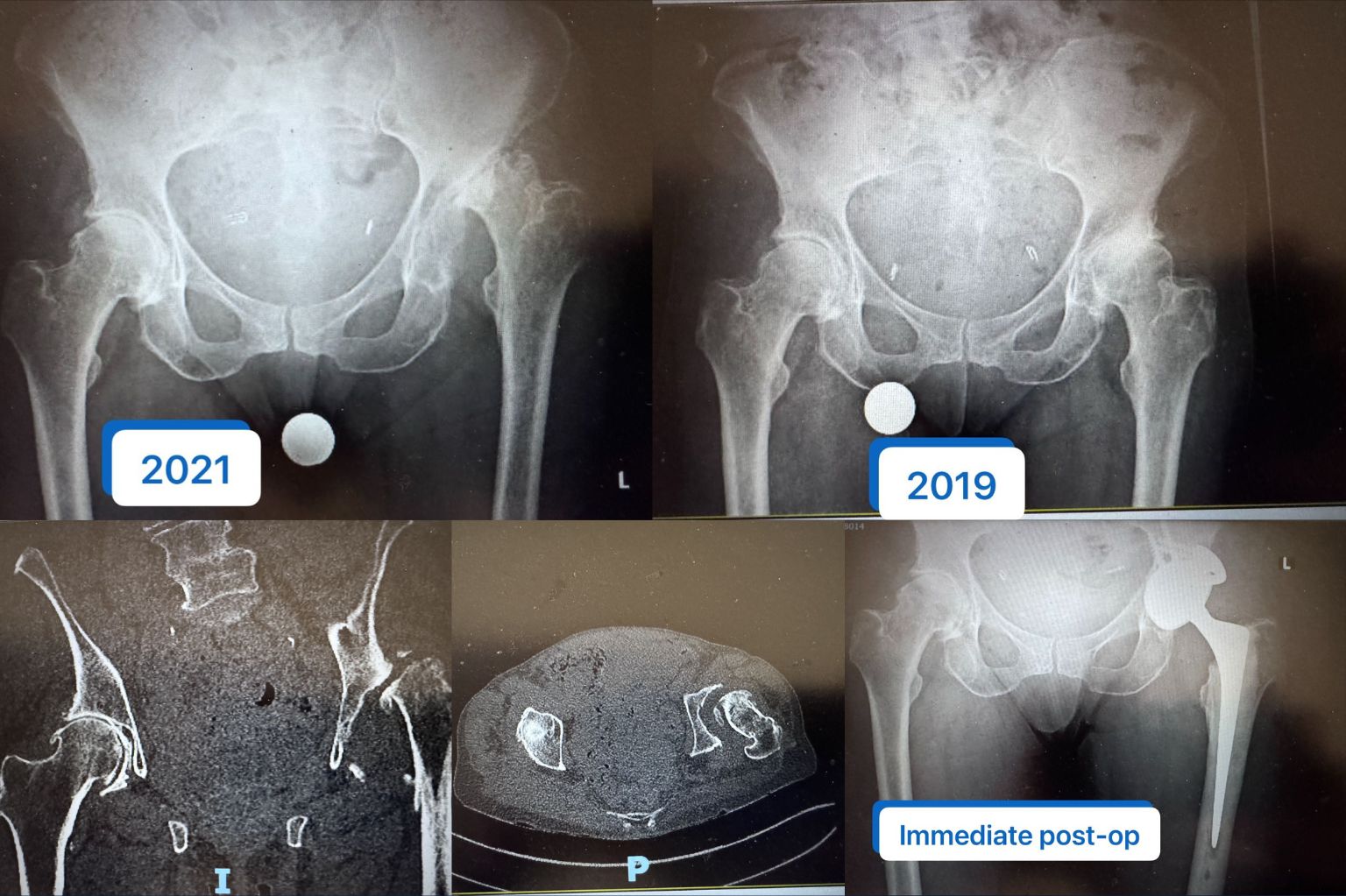
However, a repeat X-ray performed just a few weeks before the scheduled surgery told a very different story.
The imaging revealed:
- Complete collapse of the femoral head
- Significant superolateral acetabular bone loss
Given the extent of bone destruction, the patient was referred to me for complex hip reconstruction.
From Routine Arthroplasty to Complex Acetabular Reconstruction
What initially appeared to be a standard total hip replacement had now evolved into a challenging acetabular reconstruction.
The key intraoperative challenges included:
- Poor acetabular bone stock
- Loss of superolateral support
- Need for stable cup fixation despite compromised bone
To address this, we used a TMARS acetabular augment in a flying buttress configuration, allowing us to:
- Restore acetabular geometry
- Provide mechanical support to the cup
- Achieve stable fixation despite bone loss
The acetabular cup required a couple of screws, but once seated, it was exceptionally stable.
Outcome and Follow-Up
The surgery was performed in 2021. The patient was recently reviewed in the clinic, nearly four years post-operatively.
Her outcome was excellent:
- Walked into clinic pain-free
- No limp
- Extremely satisfied with the result
- Oxford Hip Score: 46
For an elderly patient who underwent complex reconstruction, this represents a highly successful functional and clinical outcome.
Reflections for Colleagues
Cases like this raise important questions for the orthopaedic community:
- Would you have approached the reconstruction differently?
- Would you have considered alternative augments or techniques?
- How often do we reassess imaging close to surgery in elderly patients?
A Question Worth Discussing
One observation increasingly discussed in hip practice is the possible association between intra-articular steroid injections and rapid deterioration of hip arthritis, including femoral head collapse and accelerated acetabular bone loss.
In this case, it prompts reflection:
- Are we seeing faster structural collapse post-injection?
- Should we be more cautious with steroid injections in advanced hip arthritis?
- Do certain patient profiles carry higher risk?
While the evidence continues to evolve, cases like this underline the importance of clinical vigilance and timely reassessment.
Final Thoughts
Hip replacement surgery is never just about implants—it is about judgment, timing, and preparedness for complexity. What starts as a routine case can quickly transform into a reconstructive challenge, and the outcome depends on recognising that change early and responding appropriately.
Struggling with Hip or Knee Pain?
Hi, I am Dr Amir Azam, a Consultant Hip and Knee Surgeon in North Wales.
I help people regain mobility and live pain-free lives through advanced hip and knee surgery. I specialise in hip replacement, knee replacement, and revision surgery (re-do surgery for failed hip and knee replacements), offering care across both the NHS (National Health Service) and private practice. With years of experience in hip and knee surgery, my focus is on providing safe, effective, and personalised treatment for every patient.
I am also registered with leading private medical insurers, including AXA Health, BUPA, Vitality Health, WPA, Aviva, Cigna, Allianz Partners, and Healix Health Services Ltd, enabling seamless access to private orthopaedic care for insured patients.
Book your consultation today and take the first step towards safe and effective recovery.
Your recovery journey doesn’t end here, and neither do my insights. I share fresh updates on LinkedIn, where we can connect directly.
Prefer short, practical tips? You’ll find those on my my Instagram and X (Twitter).
Whether you’re a patient seeking trusted care, a healthcare professional looking for collaboration, or a journalist seeking expert medical insights, I’d be glad to connect.
For appointments or any other enquiries, please email secretary@dramirazam.com.
Dr Amir Azam
Consultant Orthopaedic Surgeon
MBBS, MS (Orth), MRCS, FRCS (Orth)